
A high-end floating platform should never feel like a flimsy pool toy; it should feel like a private island that rivals the stability of a permanent wooden pier. You’ve likely felt that momentary hesitation when a group of friends steps onto a deck at once, wondering if the surface will buckle or if your investment can truly handle the weight of a fully stocked cooler and multiple guests. Mastering the technical specifications of inflatable dock weight capacity is the key to transforming these fears into a sense of absolute confidence and exclusivity. It’s about more than just surface area; it’s about the sophisticated tension of drop-stitch technology that allows for a rock-solid experience on the water.
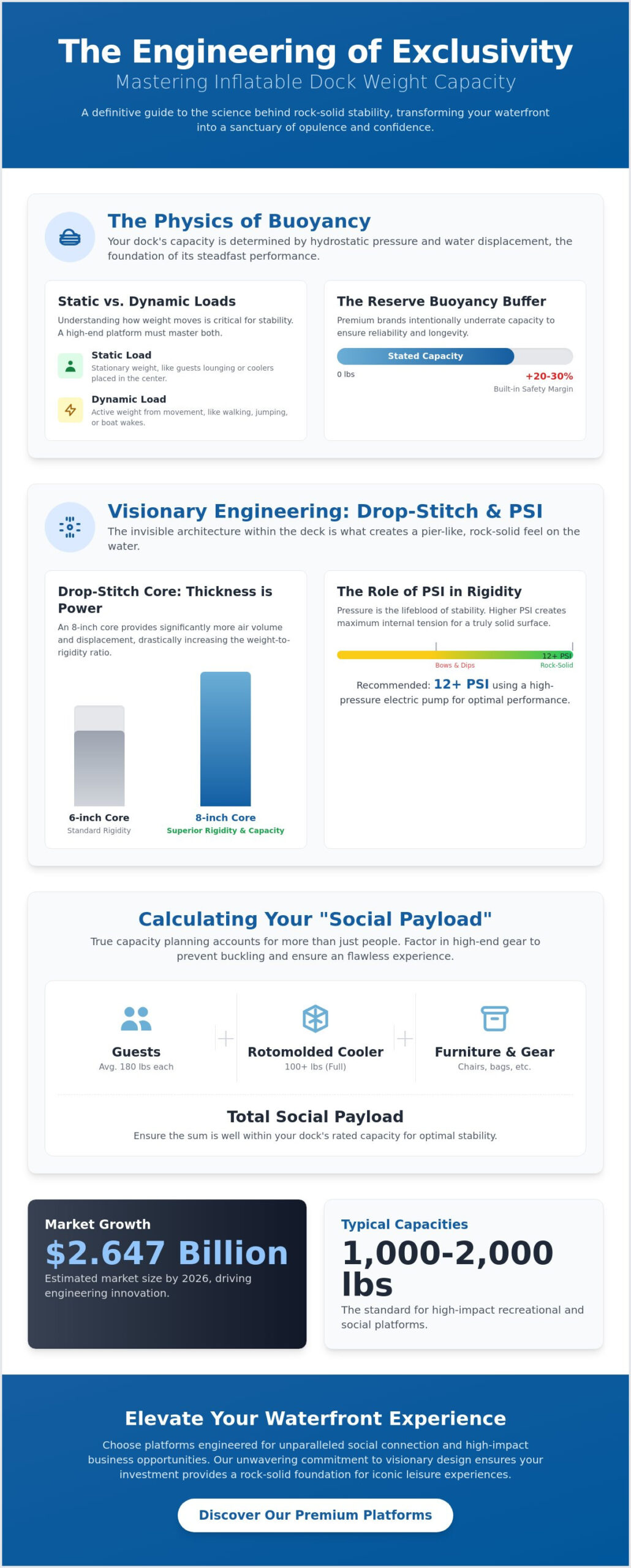
We understand that your waterfront gatherings demand the epitome of opulence and safety. As the inflatable floating dock market grows to an estimated $2.647 billion by 2026, the engineering behind these platforms has evolved to support typical capacities ranging from 1,000 to 2,000 pounds. This guide provides a definitive look at how hydrostatic displacement and high-pressure PSI create an unparalleled leisure experience. You’ll learn how to calculate load distribution, why internal tension matters more than size, and how to ensure your maritime explorations remain safe, stable, and undeniably sophisticated.
Key Takeaways
- Learn how air volume displacement and hydrostatic pressure define the maximum inflatable dock weight capacity to ensure your platform remains a rock-solid sanctuary.
- Discover why 8-inch drop-stitch cores provide a superior weight-to-rigidity ratio compared to standard 6-inch models, mimicking the feel of a permanent pier.
- Master the “social payload” calculation by factoring in both guest count and high-end gear like heavy rotomolded coolers to prevent unexpected buckling.
- Understand the critical role of heavy-duty D-rings and non-slip EVA foam in maintaining stability during dynamic movements and group transitions.
- Elevate your waterfront experience by choosing platforms engineered for high-impact recreational business and unparalleled social connection.
The Physics of Buoyancy: Defining Inflatable Dock Weight Capacity
The foundation of any elite waterfront retreat lies in its ability to remain steadfast under pressure. When you invest in a premium platform, you’re not just buying air; you’re securing a sophisticated engineering solution governed by The Physics of Buoyancy. Essentially, your inflatable dock weight capacity is dictated by the volume of water the structure displaces. A larger surface area allows for superior weight distribution, ensuring the deck stays flat and rigid rather than buckling or “tacoing” under the weight of your guests. This meticulous balance of displacement and internal tension is what separates a professional-grade platform from a standard recreational toy.
Static vs. Dynamic Loads on the Water
Stability isn’t a static number. While your dock might be rated for a specific poundage, how that weight moves across the surface matters immensely. Static load refers to the weight of furniture or guests lounging in place. Dynamic load, however, accounts for the energy of people walking, children jumping, or the rhythmic pulse of passing boat wakes. A dock rated for 1,500 lbs feels remarkably different when three adults stand up simultaneously in one corner. This “point loading” can stress even the most robust inflatable floating docks if not managed correctly. Distributing heavy items, such as a 100 lb rotomolded cooler, toward the center helps maintain that rock-solid feel you expect from a high-end investment.
The Safety Buffer: Why Manufacturers Underrate Capacity
Reliability is the hallmark of luxury. To ensure an unparalleled leisure-type experience, reputable manufacturers often build in a 20-30% “reserve buoyancy” buffer. This means the stated inflatable dock weight capacity is intentionally conservative. This buffer protects the integrity of the seams and valves against the unpredictable nature of open water, such as sudden wind gusts or heavy chop. Adhering to these limits isn’t just about safety; it’s about preserving the meticulous craftsmanship of your equipment. Overloading forces the internal drop-stitch threads to their absolute limit, which can compromise the platform’s longevity and its ability to provide a stable, sophisticated social hub for your inner circle.
Engineering Stability: Drop-Stitch Technology and PSI
True stability on the water isn’t just about size; it’s about the invisible architecture within the deck. The secret lies in Drop-Stitch Technology and PSI, where thousands of high-tensile polyester threads connect the top and bottom layers of military-grade PVC. When inflated, these threads pull tight, creating a rigid structure that mimics the feel of a permanent wooden pier. This internal tension is fundamental to maximizing your inflatable dock weight capacity, as it prevents the platform from sagging when guests congregate in one area. This visionary engineering ensures that your “private island” remains flat and supportive, regardless of how many people are stepping on or off.
While many entry-level products use a 6-inch core, the elite standard for luxury platforms is an 8-inch thickness. This additional two inches might seem small, but it drastically increases the weight-to-rigidity ratio. By increasing the internal air volume, an 8-inch core provides significantly more displacement, allowing the dock to support heavier social payloads without compromising its flat surface. It’s the epitome of opulence in design, providing a high-impact foundation for everything from yoga sessions to late-night cocktail hours.
The Role of PSI in Platform Rigidity
Pressure is the lifeblood of stability. A dock inflated to 5 PSI might feel fine for a single person, but it will bow and dip under the weight of a group. To achieve a rock-solid experience, you need to push toward 12 PSI or higher. This level of pressure ensures the internal threads are at maximum tension, supporting vertical weight with ease. We recommend using high-pressure electric pumps to reach these levels consistently, ensuring your platform is always ready for a high-impact social event. Higher PSI levels allow more guests to enjoy the space without the platform feeling like a common pool toy.
Material Layers and Seam Integrity
To handle the immense internal pressure required for high capacity, construction must be flawless. Premium decks utilize fusion-layered PVC, which bonds multiple layers of material into a single, indestructible skin. This prevents stretching and ensures the inflatable dock weight capacity remains consistent over years of use. Heat-welded seams are the hallmark of superior craftsmanship, offering a far more reliable bond than traditional glue, which can degrade under the stress of heat and heavy loads. For those looking to start selling party experiences, these technical details are the difference between a one-season toy and a lasting business asset.
Calculating Your Real-World Payload: Beyond People Count
Precision planning transforms a simple gathering into a concierge-level event. While most manufacturers focus solely on “people count,” true luxury lies in the details of your social payload. Your inflatable dock weight capacity must account for more than just the guests on board. You must factor in the weight of high-end rotomolded coolers, which often reach 50 to 100 lbs when fully stocked with ice and beverages. Add in luxury cabana accessories, folding chairs, and umbrellas, and the numbers climb quickly. Don’t overlook “wet weight” either. Saturated towels and the layer of water tracked onto the surface by swimmers add a surprising amount of mass to your total load.
We’ve developed a framework to help you estimate the real-world utility of your platform. A standard 10×10 dock typically offers a capacity of roughly 1,200 lbs. This might sound like a lot, but it disappears quickly during a full lake day. For example, six adults weighing an average of 175 lbs each already account for 1,050 lbs. Once you add a full cooler and personal gear, you are at the limit. Understanding these numbers ensures your waterfront gatherings remain safe, stable, and sophisticated.
The “Group and Gear” Calculation Framework
Use the following estimates to plan your next excursion and ensure you don’t exceed your inflatable dock weight capacity:
- 8×8 Platform: Approximately 800 lbs capacity. Ideal for 3-4 adults and light gear.
- 10×10 Platform: Approximately 1,200 lbs capacity. Perfect for 5-6 adults, a large cooler, and furniture.
- Full Cooler (75qt): 75-100 lbs depending on ice and drink volume.
- Luxury Accessories: 20-50 lbs for umbrellas, chairs, and Bluetooth speakers.
- The “Wet Factor”: Add 5% to your total guest weight to account for water and wet gear.
Weight Distribution Tactics for Maximum Stability
Strategic placement is the secret to a stable social hub. The center of the deck is the strongest point for heavy, static items like large coolers or central furniture. When boarding multiple guests from a boat or pier, use the “counter-weight” method. Have guests move to the opposite side of the boarding point to keep the platform level. This prevents the edge from dipping and ensures a seamless transition for every guest. Even weight distribution is critical when children or pets are part of the group. Their movement is often more dynamic and unpredictable, requiring a proactive approach to loading to maintain that rock-solid experience.
Stability Features That Support High Weight Capacity
Engineering a platform that remains level under a full social load requires more than just high-pressure air. It’s the synergy of high-end materials and structural features that creates a truly stable environment. While previous sections detailed the internal threads, the external stability features manage how the deck interacts with the water’s surface. A high inflatable dock weight capacity is only effective if the platform can resist lateral forces and guest movement without shifting or dipping. The thickness of the core acts as a primary stabilizer here, providing the buoyancy needed to keep the top surface well above the waterline even when fully loaded with guests and gear.
Walking from edge to edge on a premium deck should feel indistinguishable from a permanent pier. This “stiffness” is achieved through meticulous craftsmanship and reinforced sidewalls that prevent the material from stretching. When multiple adults congregate on one side, these features work together to distribute the pressure across the entire surface area. This ensures the platform remains a sophisticated retreat rather than a tilting hazard. It’s this level of reliability that defines a high-impact recreational business asset.
Anchoring Systems for Loaded Platforms
Security is paramount when hosting a large group. Supporting more than four adults requires a multi-point anchoring system to prevent the dock from drifting or flipping in heavy wind. Heavy-duty stainless steel D-rings are essential for these connections. We recommend using bungee dock lines, as they act as shock absorbers for the platform. These lines dissipate the energy of guest movement or passing wakes, preventing the anchors from pulling loose. Choosing an anchor weight that matches your dock size and guest count ensures your social hub stays exactly where you intended, providing a sense of calm and exclusivity for everyone on board.
Deck Pads and Traction Under Load
Safety must scale with capacity. As a platform reaches its maximum inflatable dock weight capacity, it naturally sits slightly lower in the water. This makes high-traction surfaces critical for preventing slips. Non-slip EVA foam pads provide a soft, luxurious feel underfoot while adding a functional layer of structural rigidity to the top surface. These pads are essential for maintaining safety on lake floats for adults, especially during high-activity use where guests are frequently moving between the water and the deck. The foam provides a reliable grip that remains effective even when the surface is wet, ensuring your waterfront gatherings are as safe as they are stylish.
Ready to elevate your summer with a platform built for ultimate social connection? Explore our high-capacity inflatable decks designed for professional-grade stability and luxury.
The Inflatable Islands Standard: Premium Engineering for 2026
Inflatable Islands Co. was founded on a visionary principle: to bridge the gap between rigorous maritime engineering and the serene grace of a luxury resort. Our journey began by identifying a critical flaw in the market, specifically the lack of stable, high-capacity platforms for group gatherings. Over the years, we’ve evolved from a boutique design house into an industry leader, framing the future of water-based entertainment. Our 2026 collection is the culmination of this legacy, standardizing the 8-inch drop-stitch core to redefine the inflatable dock weight capacity. We’ve remained steadfast in our commitment to eco-friendly design, ensuring that our Premium Personal Retreats offer guilt-free luxury while preserving the pristine waters we love to explore.
This commitment to innovation allows us to integrate expansive social features, such as floating canopy party islands, without sacrificing the buoyancy or structural integrity we’ve spent years perfecting. It’s an unparalleled leisure-type experience built for the sophisticated explorer who demands both performance and prestige. By prioritizing meticulous craftsmanship, we’ve created a product that serves as the gold standard for high-end waterfront activities.
Why Our Decks Outperform Standard Floats
The difference between a common “party float” and our commercial-grade inflatable decks is found in our proprietary fusion-layering and high-tensile internal threads. While standard products bow under pressure, our platforms maintain a rock-solid surface that mimics a permanent pier. This rigidity is the epitome of opulence, providing a high-impact foundation for everything from sunrise yoga to sunset cocktail hours. We’ve engineered these decks to handle the dynamic loads discussed earlier, ensuring that your investment remains a reliable asset for years to come.
Ready for Your Next Waterfront Social?
In an era where discretionary income is increasingly directed toward unique, high-value experiences, our platforms provide an exceptional perceived value per dollar. For entrepreneurs, this creates a low-barrier entry into a Micro-Rental Program or a high-end concierge offering. Our decks act as the central hub for all-day Maritime Exploration, offering massive capacity on the water and effortless transport on land. It’s time to stop renting basic equipment and start selling party experiences that leave a lasting impression on your guests and your bottom line.
Experience the stability of Inflatable Islands Co. platforms today.
Secure Your Place on the Water with Unmatched Stability
Mastering the technical nuances of inflatable dock weight capacity is the final step in curating your perfect maritime retreat. You now understand that a rock-solid experience relies on the invisible architecture of military-grade drop-stitch technology and the relentless tension provided by high-pressure valves. By moving beyond simple guest counts to account for high-end gear and dynamic social loads, you ensure every gathering remains a safe, sophisticated affair. Our 2026 standards prioritize this meticulous engineering, allowing you to host with total confidence regardless of the water conditions.
The days of settling for flimsy pool toys are over. It’s time to embrace the prestige of a platform designed specifically for social gatherings and heavy gear. Whether you’re expanding a private waterfront or launching a high-impact recreational business, the right equipment makes the difference between a simple float and a luxury destination. We’ve engineered our decks to provide the rigidity of a permanent pier with the versatility of a modern inflatable.
Upgrade your waterfront with a premium Inflatable Floating Deck
Start creating unforgettable memories on a platform that stands as the epitome of opulence and reliability. We look forward to seeing you out on the water.
Frequently Asked Questions
What is the average weight capacity of a 10×10 inflatable dock?
A premium 10×10 platform typically offers an inflatable dock weight capacity of approximately 1,200 pounds. This volume comfortably supports a social payload of about six adults along with essential gear like high-end coolers and folding chairs. It’s engineered to provide a stable, sophisticated retreat that remains well above the waterline even during active social gatherings.
Can an inflatable dock hold a motorized jet ski or small boat?
Most inflatable decks are not designed to support the concentrated weight of a motorized jet ski or boat directly on the surface. While the total buoyancy might theoretically handle the mass, the “point loading” from a hull can cause the platform to buckle or sustain material damage. We recommend using the integrated heavy-duty D-rings to securely dock your watercraft alongside the platform for a seamless transition.
How does PSI affect the weight capacity of my floating platform?
Internal air pressure is the primary driver of vertical support and surface rigidity. When you inflate your deck to a professional standard of 12 to 15 PSI, the internal drop-stitch threads reach maximum tension. This creates a rock-solid foundation that prevents the deck from sagging or bowing under the weight of multiple guests, ensuring the platform mimics the feel of a permanent wooden pier.
Is it safe to have a grill or fire pit on an inflatable dock?
Using grills or fire pits on an inflatable surface is strictly prohibited due to the extreme risk of heat damage or puncture from stray embers. Even with protective mats, the intense heat can compromise the military-grade PVC and heat-welded seams. To maintain a safe and unparalleled leisure-type experience, keep all heat sources on the shore or a traditional vessel away from the inflatable material.
What happens if I exceed the recommended weight limit on an inflatable dock?
Exceeding the inflatable dock weight capacity often causes “tacoing,” where the center of the deck sinks and the edges curl upward. This displacement makes the surface unstable for guests and places immense stress on the internal polyester threads and valves. Overloading the platform can lead to long-term structural fatigue, compromising the exclusivity and safety of your future waterfront explorations.
How do I calculate the weight of my group and gear for a lake day?
Start by estimating an average of 175 pounds per adult and add the confirmed weight of heavy accessories like a 100-pound rotomolded cooler. It’s also vital to include a 5% “wet weight” buffer for saturated towels and water tracked onto the surface. This proactive calculation ensures you remain within the safety buffer recommended for high-impact recreational use in open water conditions.
Does the thickness of the inflatable dock (6″ vs 8″) matter for stability?
Thickness is a fundamental stabilizer because an 8-inch core provides significantly more water displacement than a standard 6-inch model. This extra volume creates a superior weight-to-rigidity ratio, allowing the platform to sit higher in the water and resist dipping. For those seeking the epitome of opulence, the 8-inch standard is essential for supporting larger groups without the deck feeling flimsy or unstable.
How should I distribute weight on the dock to prevent it from flipping?
Place your heaviest static items, such as large coolers or central cabana furniture, as close to the center of the deck as possible. When guests are boarding from a boat or pier, have others move to the opposite side to act as a counter-weight. This strategic distribution keeps the platform level and prevents lateral forces from causing the edges to dip, ensuring a calm and exclusive environment for everyone.